Thursday, 14 January 2016

Production

The production of my animation involved the use of photoshop. 
It was predominately made using tweens to give a sharp movement keeping in with the desired comic book style of animation.

This project was a first for me using Photoshop for the vast majority of the animation process and I found it to be easier than I imagined. 

The use of tweens really gave me an advantage for getting the effect I wanted, however, I did experience quite a bit of ghosting between the frames which I wasn't 100% sure how to turn off but luckily I thought this added to the effect quite nicely. 


I decided that perhaps animating a whole music video would be quite an ambitious project to do well within the time contraints therefore the idea changed to be a trailer which shows off the band. I really like how this had turned out.


Creative Response

I decided to create a short trailer for the virtualised version of the band Nirvana.I chose to design the characters in a way that reflects the general vibe of the band which is quite dark and rugged.


I decided to adapt this into a sort of comic book style, quite similar to the style of the Gorillaz.


Initially, I had chosen to create a full animated music video for a song of Nirvana's but alongside attempting to write my paper, this would have been a very ambitious task to take on. 

The majority of the animation was created using Photoshop with the use of tweens to then be edited using iMovie. 

My chosen track is an instrumental version of 'Tourettes' by Nirvana. I chose this as I didn't want a song with words in so I thought this would be a great track (very grungy) to use to portray the vibe of the band to compliment the animation.

Research #2

340939 

I found this book 'Bubblegum Music Is The Naked Truth: The Dark History of Prepubescent Pop from the Banana Splits to Britney Spears' to be very helpful when writing the chapter on virtual bands. 

The book offered extensive information on the Archies (a virtual band that is known by many) and a lot more information on perhaps more obscure virtual bands.  It served as a great reference book for an otherwise overlooked musical genre. On the other hand it provides a look at the blatantly commercial, sometimes deceptive and occasionally cynical aspects of pop music which made for a very interesting read.

Research #1

http://ecx.images-amazon.com/images/I/51VHLlfCtVL._SX328_BO1,204,203,200_.jpg 


This book, Money for Nothing: A History of the Music Video from the Beatles to the White Stripes, has been a great help in researching the history of the music video. 
It involves an extensive amount of information on classic animated music videos and the technologies used. It offered a great insight to the difficulties of animating music videos in the late 70s/early 80s.

Friday, 18 September 2015

COP Level 6 idea

6000-9000 word written dissertation

I have decided to focus my dissertation on the art of the animated music video. I have always found the use of animation and music together a very expressive art form and would like to look further into it. 

I will be looking into the history of the animated music video and discussing how the development of technology has aided the many different styles of animated music videos over the years. 
I will also be discussing topics such as the 'virtual band' which conspires of physical musicians with completely animated members fronting the band and how they have created their very own genre of music over the years. 

Shorter chapters will include the discussion of the opportunities of the animated music videos along with some success stories of amateur animators creating well known animated music videos and what potential animated music videos will have in the future. 


Practical

For my practical, I will be making an existing band into a virtual band. At this moment in time I am not 100% sure on which band/artist I will choose to animate, but whichever it may be, I will attempt to keep the animation style in accordance with the image of the band. 

Wednesday, 25 March 2015

Animation

The practical side of COP for me is making an animation discussing some points of my essay.

The idea is to have a talking blob (so it is neutral) discussing the points written on the scene.

To create the animation, I used a software called Paint Tool SAI.

I will admit that this animation is very rushed. I was misinformed that we had an extra week on top of the deadline to complete the practical so was led to have a false sense of time. I know I shouldn't believe everything I hear and I know I need a better approach to time management so I apologise for the quality of it. It was very last minute.

Tuesday, 10 February 2015

Globalisaton, Sustainability and the Media contextualisation

- Globalisation in Animation.
Disney. 
      Globalised animation. The spread of Disney to the rest of the world.

Has Globalisation/ Americanisation helped the animation world?
Does Disney ruin Grimms fairytales? It makes them all pretty and perfect and happy instead of the original story. Better for modern children.

Westernisation - Characters etc. become more westernised when done in America? Does culture get lost? Good that other cultures are used, but not always true to reality. Facial characteristics are often Americanised or stereotyped.

Sometimes other cultures use american things to influence their animation. Sometimes Japanese animation has american themes, sometimes American animation has Japanese themes such as Studio Ghibli.

TV and Film as well as animation influence the world- eastern cultures (India etc) sell skin lightening cream because of the idea that western culture is better- White skin is everywhere on TV and people start to believe that white skin = happiness and sucess.

The media decides what people know about. Supports the idea that western culture is better, people are richer. 

National identity in Animation?
American animation is very similar
British animation looks very different from different studios, but interchangeable.

Americanisation has stereotyped British culture to the rest of the world. Patriotism- The Queen brings in tourism and money. The media presents the Royal Family to the rest of the world, but a large amount of the British public don't think the Queen does much for the country/ doesn't know what she does. 

Cultural differences in different animations? How animation has changed in cultures before and after americanisation. Has americanisation affected the world of animation?

Monday, 19 January 2015

Globalisation, Sustainability and the Media

Definitions of Globalisation
-Socialist:
Transformation of local or regional phenomena into global ones. The people of the world are united into a single society and function together.
-Capitalist:
Elimination of state- enforced restrictions on exchanges across borders and the integrated and complex global system of production and exchange.

Process of economic liberalisation.
-Freeing up of the market.
Local and national boundaries collapsing to unify the world as one.

McDonalidization- coined by George Ritzer 
-Wide ranging sociocultural processes by which the principles of fast-food restaurants are coming to dominate America and the world.

Principles of fast food
- low skilled, unimportant jobs with low salaries, high profit and no chance of moving up in the job. 

Marshall McLuhan- Understanding Media. 1964.
With radio we hear more of the rest of the world and with TV we can see more from the rest of the world.
Increased humanity of the world.
'As electrically contracted, the globe is no more than a village'
-everyone knows each other and empathises.

'The electronic age has healed the entire human family into a single global tribe.' 1968
unfortunately this hasn't happened. Thought businesses would work together.

Centripetal forces- bringing the world together in uniform global society.
Centrifugal forces- tearing the world apart into tribes.

Problems of Globalisation:
-Sovereignty- challenges to the idea of the nation/ state.
-Accountability- transnational forces and organisation- who controls them? no one.

Multi-national companies moving base to avoid legislation that would stop them doing what they're doing.
If the 'global village' is run with a certain set of values then it would not be so much an integrated community as an assimilated one.

Media Conglomerates operate as Oligopolies. American culture spreads to the whole world. Apparently America controls the world...

News corporations divide the world into 'territories' of descending 'market importance.'

Not a global free market, a globalized marked that entirely focusses on America.

Big Brother- global.

India- selling a lot of skin lightening cream- possible because they're constantly surrounded by western images presenting that to be successful or beautiful is to be white. 

Chomsky and Herman (1998)
Propaganda Model. 5 basic filters.
-Ownership
-Funding
-Sourcing
-Flak
-Ideology (eg. Anti-Islam)

Ownership- Rupert Murdoch owns
-News of the World (defunked for criminal activity)
-The Sun
-The Sunday times
-The Times
-Fox TV
-BSkyB etc
He knows his influence and takes advantage of that.
The Sun has the influence to persuade people who they should vote for in elections.

- Sourcing
The news is only as good as the access you have to the source. If you do get to interview the important people, you have to present it how they want you to or you'll be out of a job and blackballed so if you tell the truth, no one believes you.

- Funding
Corporations have control over the media because they have money.
They Sun, known for lazily stereotyping people and places to sell/ market to people. brings an idea of us vs them. 
Gives people someone to blame for poverty and unemployment other than the government -> 'Blame immigrants'

Flak
-Organised body of people who lobby against organisations and ideas of the world. Global Climate Coalition created by fuel companies with money to lobby against the idea of climate change. It aimed to convince people that climate change wasn't real. Arguing against politicians.
Al Gore 'An inconvenient truth' -suggests global warming is a moral issue, not a political issue. Raising awareness- glaciers melting etc.
Flak groups decided to fight against it because they refused to believe it. Decided it was propaganda and a hoax because they didnt want to lose money by being environmentally friendly. "CO2 is life, not a pollutant"

- Sustainability
-Mass production of anything sustainable is impossible. The two contradict each other. 
"Most things are not designed for the needs of the people, but for the needs of the manufacturers."

The story of stuff 2007. Free Range Studios/ Annie Lennard - Animation
Been shown in over 200 countries. 12 million people have seen it. 
Very influential, low budget. We can change the world.

Subculture Contextualisation

- Many animations poke fun at subcultures.

- Subcultures are trying to be different to the larger culture. They disagree with the things the larger culture believes in. 
Trying to be different but in a group of like minded people. 

- Daria - is she part of her own subculture? She doesn't really want to fit in. Her friends fit the goth subculture style. 

- Films that focus on subcultures often stereotype that subculture. 

- There are subcultures still around but they're a bit harder to pin point different subcultures. 
We have the freedom to dress and look how we want, so seeing people dress differently isn't as shocking to this generation. 

- Animations that might fit a subcultures. 

- If you are trying to represent a subculture in animation, do you have to stereotype the subcultures so that people understand what you're representing? 
When subcultures become mainstream the clothes appear on the high street and suddenly everyone is wearing it. Makes it hard to know who likes something and who is just dressed like that because it's 'cool' without knowing anything about it. Ramones merchandise from shops such as Primark is a key example of this.  
Can be considered potential offensive to people who really like it, even though it makes it readily available to them. 

Tuesday, 13 January 2015

Cities and Film

- The city in Modernism
- The possibility of an urban sociology
- The city as public and private space
- The city in Postmodernism
- The relation of the individual to the crowd in the city


The first person to attempt urban sociology was Georg Simmel (1858- 1918) 
Author of Metropolis and Mental Life in 1903
German sociologist, he reflects on the individual.
This is the time when fraud wrote his lectures on psychoanalysis 

At this time the growth of the city was exponential, it was new and different.
Get the idea of the vulnerability of the city - people had to learn new things i.e. traffic lights and other such inventions.

Architect Louis Sullivan (1856-1924)
- Organised into 4 zones
- Contains mechanical, utility area, public area, office space, no decorative elements.

Terminating zone.
- Responsible for the redesign of the skyline in Chicago.

Manhatta (1921) Paul Strand and Charles Scheeler (Film)
- City of Manhattan
- Melting pot of immigration, idea that all races are here. 
- Proud, passionate city. 
- Celebration of transport and build environment. 
- Contains a detached view of the city

Ford Motor Company's plant at River Rouge, Detroit (1927)
- Notion of Fordism - repetitive nature of the production mine almost turns the worker into the machine.
The idea that people go to work in this industry but only earn enough to buy the product themselves.

Friday, 2 January 2015

Identity

- The subject of identity is seen as a controversial issue, especially in the past. 

- Essentialism is the theory that everything has a set of characteristics that makes it what it is. The same goes for people - it is believed that you are born a certain way, but each has different characteristics so you can tell the difference between, for example, a man and a woman.

- Everybody has an identity; supposedly we can be whoever we want to be and we shouldn't be judged for it, but that's not necessarily the case within society. 

- In the past there was an extremely contorted version of the ideal identity; that if you didn't look or act a certain way then you weren't deemed intelligent or beautiful. This borders on racism and sexism suggesting that white men are smarter and generally better then black men or women in general. 

Friday, 19 December 2014

Psycho-Analysis and Freud in Animation


Common misconceptions

-it's a mish mash of psychology (behaviour) and psychiatry (mental illness)

-it's all about sex. 

Iceberg metaphor. 
Consciousness above surface.
Unconsciousness below surface. 
90% is below the surface. 

Consciousness- made up of the 'ego'- the side we show the world. 

Our 'super-ego' is what lies beneath the surface. 

The 'ID' is what drives our sexual desires and impulse decisions and instinctual desires. 

Psycho-analysis is interested in art & design & media because it explores the deep desires. 

Wednesday, 12 November 2014

The Meaning of Style

Hebidge, D (1979) 'Subculture: The Meaning of Style'
- "Youth cultural styles begin by issuing symbolic challenges, but they must end by establishing new conventions; by creating new commodities, new industries, or rejuvenating old ones."

- The reason people form and become part of subcultures is because the ideas of the mainstream/everyday values do not appeal to that particular person. They are symbolic challenges to the norm, thus making them exciting. 
Unfortunately they often end up turning into commodities and industries to be sold back to the people rebelling against the system. They get sucked into the mainstream.

- As soon as the media gets a hold of the subcultures ideas and styles, and writes about it, whether in a positive or negative way, it becomes popular and the subculture becomes marketable and mainstream. 

- Punk was about rewriting the rules of what it was to be a man, how to make music, how to dress, and what it was to be British and , in particular, from London. It was a refusal to conform.
It got bad press and was thought to be bad people, no parent wanted their child to be a punk. It was quite frowned upon.

- Eventually, subcultures get sucked back into the mainstream as their idea of rebellion is being sold back to them.

INCORPORATION- How mainstream sucks subcultures back in.
IDEOLOGICAL FORM- The system makes the subcultures ideas and style seem ridiculous and irrelevant. Eg. selling fake mohawks for fancy dress, making fun of the style. 
COMMODITY FORM- The system starts selling things aimed at the subcultures style , making the subculture part of the mainstream and stops it rebelling.

Tuesday, 14 October 2014

The Gaze and the Media

In 1972 John Berger said that women are forced to carry an image of themselves in their heads. They regard themselves as being looked at so maybe make more of an effort and put themselves out there.

This image is called Vanity and it is by Hans Menling.
It seems as though we are given permission to look at this womans body because she is looking at herself in a mirror. This breaks eye contact with the audience.


Another example of this is Alexandre Cabanels birth of venus.
In this image, her arm is over a lot of her face. 
Again, this means she isn't looking back which means we aren't being challenged and she is giving us permission to look at her body.


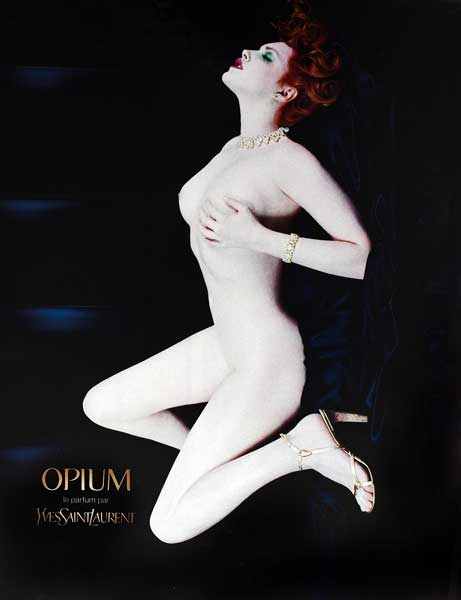
This is the same kind of image but with photography. It was used as an for YSL's Opium advertisement in the 90's. The nature of this photo was considered far too sexualised to be out for the general public to see. Partly the hand on the breast which actually covers her modesty and partly because the attention is drawn to her body.


However, when they turned the image on its side, the focus became more on the face so this was considered okay to use. 


In the below images (left: Titans venus of vurbino-1538, right: Monet-Olympia 1863) they are quite similar in composition. However there are subtle differences. On the left the woman is very relaxed with a soft look of her face whereas the right is more rigid, also pay attention to the hand positioning. The left is just draped over herself whereas the right is more definitely placed as if she does not want that part of her body on display. Both images are like you have special access to their bed chambers but one is more inviting than the other.


The next images (Ingres Le grand odalisque 1814 and the edited version for a poster for the Guemilla Girls) They used this image to put on their poster advertising that less than 5% of the artists in the modern art section were women but 85% of the nudes are female. Basically, they're asking why women are mostly the ones being sexualised? 

However, this poster was seen as being too sexually suggestive with the fan in her hand so it got pulled.


This is Coward.R the look from 1984. In this image there is a barely dressed woman in the city streets and everyone around her is just going about their daily business as if she wasn't there. This shows the normalisation of nudity. In this image the camera is an extension of the male gaze.


This image of Eva Herzigova was on a billboard and ended up stopping traffic because people were slowing down to look at it. That shows that sex sells because people want to look at it.


This advertisement for Dolce and Gabbanas male underwear line still had nudity in the ad but the way the models are all looking directly at the camera is challenging the viewer so it makes it not as okay to look and you pay more attention to their faces because they're connecting with you.


Images such as this which is a celebrity caught unaware by Cindy Sherman are liked because everyone wants an insight into a celebrities life and want to see more of them. The sunglasses here are used much like the mirror at the beginning of the post and the arm over the face. It's to distance the gaze from the viewer to make it okay to look at her.

An example of people wanting to see more from celebrities is big brother. people just sit there and watch other people. But the women on the show are very aware they are being watched and almost perform to it like they are very aware of how they look.


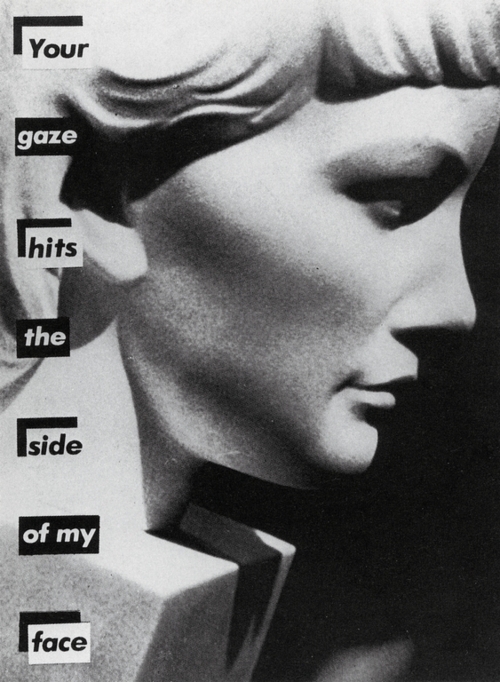
Your gaze hits the side of my face by Barbra Cruger has like a double meaning. Its like yes you look at the side of her face but also the word 'hits' could mean like you literally hit the side of her face like this whole thing with the media and portrayal of women is damaging her. 


Tracey Emin challenges this kind of portrayal of women with this photo showing that money is more important-thats what people want, thats what they see in this photo. Not the fact its between her legs. Another way you can look at the photo is that a womans body makes money.


Saturday, 22 March 2014

Post Modernism

- 'Postmodernism Term applied to a wide range of cultural analysis and production since the early 1970s. Whilst there are different attitudes to what postmodernism is, it is generally referred to as a significant shift in attitude away from the certainties of a modernism based on progress.
The cultural traits usually associated with postmodern cultural production include the acceptance of many styles, the importance of surface and the playful adoption of different styles through parody and pastiche.'

-'Term used from about 1970 to describe changes seen to take place in Western society and culture from the 1960s on. These changes arose from anti-authoritarian challenges to the prevailing orthodoxies across the board. In art, postmodernism was specifically a reaction against modernism. It may be said to begin with Pop art and to embrace much of what followed including Conceptual art, Neo-Expressionism, Feminist art, and the Young British Artists of the 1990s. Some outstanding characteristics of postmodernism are that it collapses the distinction between high culture and mass or popular culture; that it tends to efface the boundary between art and everyday life; and that it refuses to recognise the authority of any single style or definition of what art should be.'


Modernism roughly 1860-1960
Logically Postmodernism is 1960-date

Modernism:
- Aspirational reaction to improve peoples lives.
- Form follows function

Le Corbusier, Villa Savoye, Poissy, 1928 - 9

- Pare-dime of modernist architecture
- Minimalism, functionality

Post Modernism: 
- Reaction to modernist rules
- 21 yrs later WW2 starts and the same thing happens again (art form as a response)

Robert Venturi:
- ‘I like elements which are hybrid rather than “pure”, compromising rather than “clean”, distorted rather than “straight-forward”, ambiguous rather than “articulated”, perverse as well as impersonal....’

Sensburies ring in London (watered down version of Postmodernism)
- (Prince Charles quote) 'A monstrous….something'
- Bricolage (DIY) Mixing up of styles and materials 
- Parody create humour for Postmodernism.

Le Corbusier, Chapel of Notre Dame du Haut, Ronchamp, 1953 - 5 
- Set the notions for Postmodernism
- Las Vegas sums up Postmodernism - cultural identity? Opinions may vary
- There is no truth to material - all squeezed into one place
- Idea of something with an immediate thrill instead of waiting
- Las Vagas sums up that aspect in Postmodernism (disney world)


Philip Johnson, Sony Plaza (former AT&T Building), New York, 1978 - 84
- Roman tribe arch, decorative piece on top like a wardrobe
- defying the laws of modernism.

James Stirling, Neue Staatsgalerie, Stuttgart, Germany, 1977 - 1983
- Garish colours, colour coded. 
- It sticks 2 fingers up at the the Modernists
- Placed close to Notre Dame (historical area)
- Bright vibrant, slightly tacky?


James Stirling, Neue Staatsgalerie, Stuttgart, Germany, 1977 - 1983 (Post War Period)
- Carries of with garish colours
- Plays on heritage of museum
- Covered in basing of stone - underneath cheap construction
- Its meant to be humorous - pretending to be old
- Marble cladding - relatively cheap (blocks falling out the wall - create old illusion)
- Modernism would not of done this!

- Crome plated kettle (does same as the camping one)
- Taking all functions of previous design but spend more.
- The same with the orange or lemon squeezer.
- Looks like its walked out of a 1950 SCI FI movie
- Status - what Postmodernism is about (if you have money to spend)
Form is functional but the idea goes further.


Warhol Campbell’s Soup Cans, 1962
 (first to make a big deal)
- Taking screen printing, taking a piece of everyday sustenance (soup - Graphic Design) and
turns it into a piece of fine art. 
- Postmodernism democratises art. 

Lichtenstein does the same. Drowning Girl, 1963
- Replicates the dots of print. 
- Dumbing down? 
- Attention to detail is massive
- Taking pop culture and transforming it into fine art.

Jeff Koons
- Things reported in popular press? (Michael Jackson)
- Tacky porcelain model

Michael Craig Martin
- Does he believe his work is actually an oak tree?
- Mocking the congratulatory factor

Tracey Emin, Everyone I have ever slept with 1963 - 95, 1995
-Women have been represented in fine art and now coming to the fall in Postmodernism.
- Traditionally artist are men. Women feel they need to branch out and show they haven’t been recognised etc.
- The way society perceives women - sluts?
- Picasso is praised for sleeping with lots of models and this is almost a response as to why she does deserve the same praise.
- Auto biographical
- Buries her soul

Sarah Lucas, Au Naturel, 1994
Is it acceptable because it was made by a woman?

Jake and Dinos Chapman, Zygotic acceleration, biogenetic, de-sublimated libidinal model X 1000,1995
- Cloning? Suggests we all are clones?
- Scary, shocking
- Serious statement whether scientist can produce this?
- Confrontational 

Chris Ofili No Woman, No Cry 1998 and Holy Virgin Mary, 1996
- Talks about marginalised discourses 
- Steven Lawrence was murdered in race hate crime
- Representing black society in Britain
- Rastafarian colours
- Obvious links to black colours
- Larger than life - uses elephant dung (baked in sun)
- New yorkers were horrified to see the Virgin Mary painted black.

Shithead 
- Makes serious statements for ethnic minorities
- Makes black superhero out of dung.

Martin Creed, Work No. 227: The lights going on and off 2000
- Questions whether he is the artist or the electrician 
- Simplistic (easy money)
- Masking tape - tries to be confrontational
- Either he absolutely cares or is mocking the art establishment.

David Carson, Ray Gun, double page spread
- Designed to be illegible
- Visually arresting - pleasing

Barbara Kruger - I shop therefore I am (woman artist) (part of minority)
- Lacks any spiritual content
- Defines how we shop, what we buy
- Is it still artwork or has it entered advertising
- Challenging convention (is it mocking in shops?)

Banksy challenges Warhol design
- cheap, tacky style
- is it graffiti, urban art?

- Pop art is of the early forms of Postmodernism
- Are artists wanting to challenge the conventions of art? Is that their sole purpose?


Dr. Parsons, this is me by georg bush, pen and crayon, 2001
- George bush was illiterate - childish imagery portrays that represent the publics opinions on the war in countries


Make effort to create these pieces that serve no real purpose (lightning)

Postmodern aesthetic = Multiplicity of Styles & Approaches
Space for ‘new voices’